
Words matter, especially when writing emails, school work, or office messages. Many people get confused between double check or double confirm because both sound similar. But are they both correct? Or is one better than the other?
This guide will explain everything in simple words. You will learn the real meaning, correct usage, examples, grammar rules, and when to use each phrase.
If you have ever asked yourself whether to write double check or double confirm, this article will help you choose the right one with confidence.
What Does Double Check Mean?
The phrase double check means to check something again to make sure it is correct.
It is used when you want to verify information, fix mistakes, or avoid problems. This phrase is common in daily life, school, offices, and business communication.
For example:
- Please double check the email before sending it.
- I will double check the meeting time.
- She double checked her homework.
This phrase sounds natural and correct in English. Native speakers use it often because it clearly means reviewing something one more time.
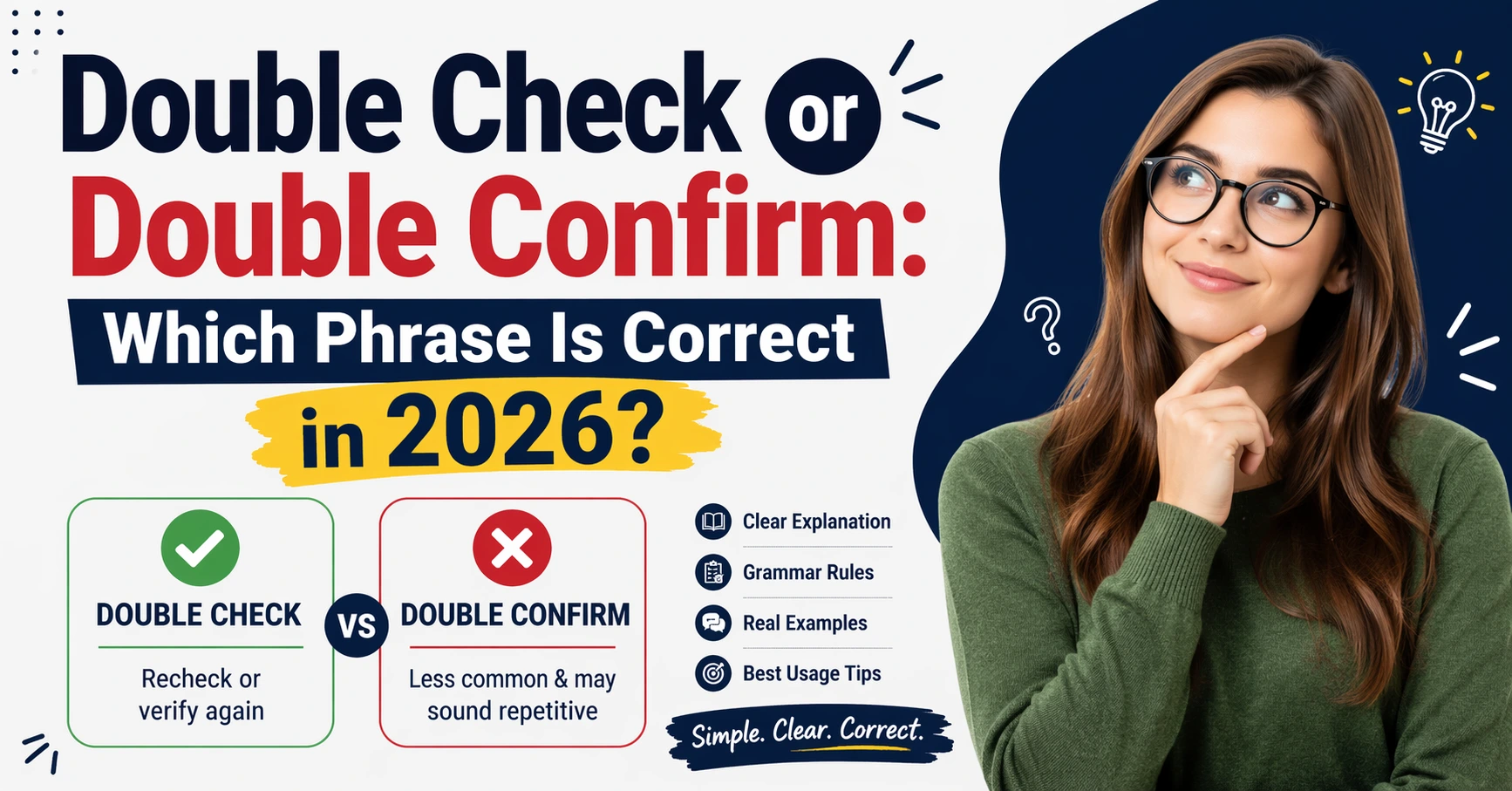
When comparing double check or double confirm, “double check” is the more common and accepted phrase.
What Does Double Confirm Mean?
The phrase double confirm is less common in standard English. Some people use it when they want extra assurance, but it is not as natural as “double check.”
Usually, “confirm” already means making sure something is true. Adding “double” can sound unnecessary.
Example:
- I want to confirm your booking.
This is already enough.
Saying:
- I want to double confirm your booking.
can sound awkward in formal English, though it may still be heard in casual speech or non-native English environments.
That is why many grammar experts prefer “confirm” or “double check” instead of “double confirm.”
Double Check or Double Confirm: Quick Comparison
| Phrase | Common Usage | Natural English | Best For |
|---|---|---|---|
| Double Check | Very common | Yes | Rechecking details |
| Double Confirm | Less common | Sometimes awkward | Extra reassurance |
| Confirm | Very common | Yes | Final verification |
| Recheck | Common | Yes | Reviewing again |
This table makes double check or double confirm easier to understand.
Which One Is Grammatically Better?
From a grammar point of view, double check is usually better.
Why?
Because “check” means to inspect, and adding “double” means doing it again.
But “confirm” already means to verify or make certain. So adding “double” may feel repetitive.
Example:
Correct:
- Please double check the address.
Better:
- Please confirm the address.
Less natural:
- Please double confirm the address.
So if you are choosing between double check or double confirm, “double check” is usually the safer choice.
Why People Say Double Confirm
Even though it sounds less natural, many people still say “double confirm.”
This often happens in workplaces, customer service, and international communication. People use it because they want to show extra certainty.
For example:
- Let me double confirm with my manager.
They mean they want to verify again before giving a final answer.
In some countries, this phrase is common in business English, even if native speakers prefer simpler wording.
Language changes with use, so while “double confirm” may not be perfect grammar, people still understand it.
Common Situations Where Double Check Is Used
You will hear double check in many daily situations.
At Work
Employees often use it before sending reports, invoices, or emails.
Example:
- Please double check the client’s name.
At School
Students use it before submitting homework or exams.
Example:
- Double check your answers before handing in the paper.
While Traveling
People verify tickets, dates, and hotel bookings.
Example:
- I need to double check my flight time.
This is why double check or double confirm becomes a common question for learners.
Common Situations Where Confirm Is Better
Sometimes you should use only “confirm,” not “double confirm.”
Booking Confirmation
- Please confirm your reservation.
Appointment Details
- Can you confirm tomorrow’s meeting?
Delivery Information
- Please confirm your address.
In these cases, “confirm” sounds cleaner and more professional.
This helps you decide between double check or double confirm more easily.
Formal vs Casual Writing
Choosing the right phrase also depends on where you are writing.
| Situation | Better Phrase |
|---|---|
| Business Email | Confirm / Double Check |
| School Assignment | Double Check |
| Friendly Chat | Double Check |
| Customer Service | Confirm |
| Office Conversation | Double Check |
In formal writing, simple and clear words are better.
That is why many professionals avoid “double confirm” and choose “confirm” instead.
Examples in Real Sentences
Let’s look at real examples so the difference becomes clearer.
| Sentence | Better Choice |
|---|---|
| Please ___ the report before sending | Double check |
| Can you ___ your attendance? | Confirm |
| I will ___ the order details | Double check |
| Please ___ your payment receipt | Confirm |
| Let me ___ with the team first | Confirm |
When thinking about double check or double confirm, examples help more than grammar rules alone.
Mistakes People Often Make
Many learners make small mistakes with these phrases.
Mistake 1: Using Double Confirm Everywhere
Wrong:
- Please double confirm your email address.
Better:
- Please confirm your email address.
Mistake 2: Using Confirm for Rechecking
Wrong:
- I will confirm the spelling again.
Better:
- I will double check the spelling.
Mistake 3: Mixing Both Together
Wrong:
- Please double check and confirm again again.
Too many repeated ideas make writing weak.
Keep it simple and clear.
Better Alternatives You Can Use
Instead of choosing only double check or double confirm, you can also use other helpful phrases.
Good Alternatives
- Recheck
- Verify
- Confirm
- Review again
- Make sure
- Cross-check
Example
Instead of:
- I will double confirm the details
You can say:
- I will verify the details
This sounds smoother and more professional.
Professional Email Examples
Here are simple examples for office use.
Example 1
Subject: Meeting Time
Hello Sarah,
Please double check the meeting time for tomorrow. I want to avoid any confusion.
Thank you.
Example 2
Subject: Booking Details
Hello Team,
Please confirm the hotel reservation for next week.
Best regards.
Example 3
Subject: Client Information
Hi John,
Can you double check the client’s contact details before sending the invoice?
Thanks.
These examples show how to correctly use double check or double confirm in real work situations.
Personal Experience: What I Use Most
In my own writing, I usually choose “double check” when reviewing details and “confirm” when asking for final approval.
For example, before publishing content, I double check grammar, spelling, and headings. But when scheduling meetings, I ask people to confirm the time.
I rarely use “double confirm” because it feels less natural and sometimes sounds too repetitive.
This simple habit makes communication clearer and more professional.
If you remember one rule from this article about double check or double confirm, let it be this:
Use “double check” for reviewing and “confirm” for final approval.
Quick Memory Trick
Here is an easy trick:
Double Check = Look Again
Confirm = Final Yes
This small memory trick helps you avoid confusion fast.
If you are reviewing details, choose double check.
If you are asking for final approval, choose confirm.
This makes the choice between double check or double confirm much easier.
Comparison Table for Easy Learning
| Meaning | Best Phrase |
|---|---|
| Review again | Double Check |
| Final approval | Confirm |
| Verify spelling | Double Check |
| Confirm booking | Confirm |
| Recheck report | Double Check |
Keep this table in mind whenever you write.
FAQs About Double Check or Double Confirm
Is double confirm wrong?
It is not completely wrong, but it sounds less natural in standard English. Most people prefer “confirm” or “double check.”
Should I use double check or double confirm in emails?
Usually, “double check” or “confirm” is better. “Double confirm” can sound awkward in professional emails.
Is double check formal English?
Yes, it is common in both formal and casual English, especially when reviewing details.
Why does double confirm sound strange?
Because “confirm” already means making sure something is correct. Adding “double” can feel unnecessary.
Can I use double confirm at work?
Yes, people may understand it, but “confirm” or “double check” sounds more professional.
Which phrase do native speakers use more?
Native speakers use “double check” much more often than “double confirm.”
Final Verdict: Double Check or Double Confirm
So, what is the final answer for double check or double confirm?
The best choice is usually double check when reviewing something again.
If you need final approval, use confirm.
“Double confirm” is understandable, but it is less natural and often unnecessary.
The safest rule is simple:
- Review again → Double Check
- Final approval → Confirm
Good writing becomes stronger when words are clear and simple.
The next time you write an email, submit homework, or send a message, you will know exactly which phrase to use.
And that small grammar choice can make a big difference.
